

As the leading authority in Indonesia’s palm biomass sector, the Association of Palm Kernel Shell Entrepreneurs of Indonesia (APCASI) provides exclusive access to comprehensive market data and vital industry trends. We empower global stakeholders with up-to-date production statistics, export volume tracking, and strategic forecasts to navigate the evolving green energy landscape. Partner with us to leverage accurate market intelligence and make secure, data-driven investments in sustainable biomass solutions.
The global transition toward net-zero emissions requires more than just ambitious policies; it demands scalable, reliable, and standardized renewable energy sources. Indonesia stands at the absolute center of this global shift, and APCASI serves as the definitive bridge connecting local potential with international industrial demand.
The Unprecedented Scale of Indonesia’s Biomass Potential
To understand the global impact of palm biomass, one must first recognize the sheer scale of Indonesia’s agricultural landscape. Indonesia possesses the largest land of oil palm plantations in the world, with an area covering approximately 15.7 million hectares. This massive footprint is supported by a robust commercial infrastructure, comprising 1,688 companies spread across 26 provinces. The islands of Sumatra and Kalimantan currently host the largest number of these oil palm plantation companies.
Beyond the primary yield of crude palm oil, the most significant potential of the oil palm plantation industry is the immense volume of biomass within the agriculture residue category. Indonesia generates an astounding 232 million tons of biomass per year in the form of dry matter. This unparalleled reserve represents a strategic industry for renewable and sustainable energy, poised to become the mainstay of the world’s green energy supply.
Deep Dive: Palm Kernel Shells (PKS) as a Premium Fuel
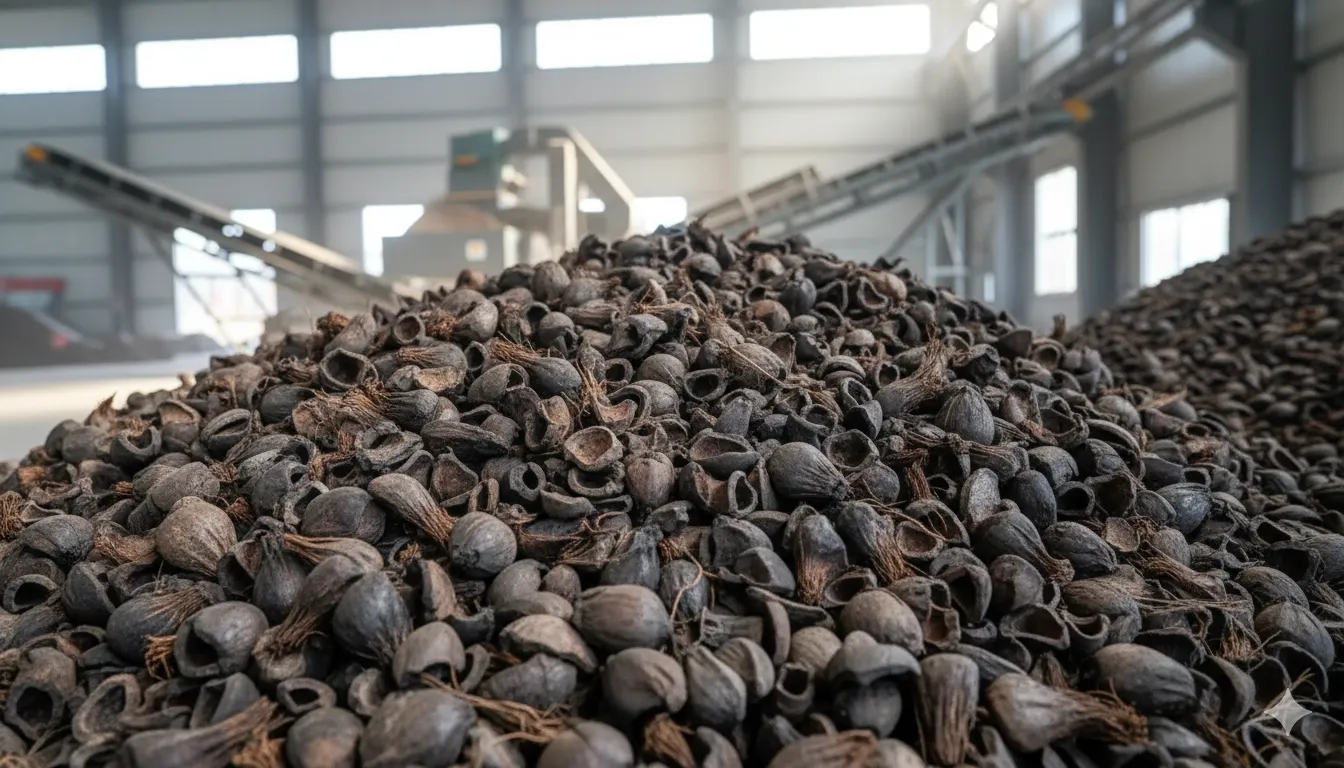
At the forefront of this biomass revolution is the Palm Kernel Shell (PKS). PKS consists of the shell fractions left after the nut has been removed following the crushing process in the palm oil mill. It has established itself as a natural, high-grade, low-carbon renewable fuel, used extensively for burning in Power Generation Plants to produce carbon-neutral, greener energy. PKS can be utilized independently or mixed with coal and other biomass, such as wood pellets, significantly reducing coal consumption and carbon dioxide emissions in industrial applications.
The biological classification of the oil palm directly influences the characteristics of the kernel shell, which is categorized primarily into two types:
- Dura (Thick Shell): This variety features a thicker shell structure, comprising 35-65% mesocarp and 7-20% endosperm.
- Tenera (Thin Shell): This variety possesses a thinner shell, containing 60-96% mesocarp, 3-20% endocarp, and 3-15% endosperm.
Compared to other industrial residues, PKS is recognized as a superior quality biomass fuel due to its uniform size distribution, easy handling, and easy crushing. A distinct advantage of PKS is its exceptionally low moisture content, which values between 11% and 13%, with some typical characteristics showing moisture as low as 8.72%. Because it contains residues of palm oil, it boasts a higher heating value than average lignocellulosic biomass, reaching up to 20,539 kJ/kg.
To ensure reliability for global buyers, APCASI enforces standard export specifications. For international trade, PKS must meet strict parameters: a maximum moisture content of 20%, maximum sulfur of 0.1%, maximum chlorine of 0.1%, and maximum impurities of 0.5%, with an ideal size ranging from 3 to 5 mm.
A Diversified and Sustainable Biomass Portfolio
While PKS is the primary export commodity, APCASI’s strategic vision encompasses the entirety of the palm biomass spectrum. A truly sustainable energy transition requires maximizing all available agricultural residues.
Empty Fruit Bunch (EFB) Empty Fruit Bunches are purely biological, fibrous materials from the fresh fruit bunch, free of chemicals or mineral additives. In 2015, the volume of EFB in Indonesia reached 17.1 million metric tons, a figure that continues to rise with plantation expansion. Because raw EFB has a moisture content around 65%, pre-processing is required to optimize it as a fuel source. Once processed, EFB provides a high heating value of 18,795 kJ/kg and is exceptionally suited for burning in Circulating Fluidized Bed (CFB) boilers, producing very low gas emissions.
Oil Palm Fibre (OPF) Produced from the vascular bundles within the EFB, Oil Palm Fibre is 100% natural, biodegradable, and environmentally friendly. OPF waste accounts for roughly 12.5% of the processing output in Palm Oil Mills. Utilizing these fibers for energy prevents massive stockpiling on plantations—which can breed pests—while providing an impressive heating value of 19,055 kJ/kg.
Oil Palm Trunk (OPT) Indonesia operates a progressive national rejuvenation program, with a target of replanting 2.4 million hectares of older, less productive trees. Trees are typically replanted at an interval of approximately 25 years. This generates an enormous amount of felled trunks, measuring 7 to 13 meters in length, providing an estimated 36 million cubic meters of raw OPT material annually. With a heating value of 17,471 kJ/kg, OPT is also highly valuable for biorefineries due to its large starch content.
Palm Oil Mill Effluent (POME) POME is a non-toxic liquid waste generated during the sterilization and condensation processes, with mills producing 600-700 liters per ton of fresh fruit bunch. Through anaerobic digestion, POME is converted into biogas. Just one cubic meter of POME can produce 37.56 cubic meters of biogas, contributing to a massive national electricity potential from palm waste that has reached 12,654 Mega Watts.
Strategic Market Data and Export Forecasts
As the center for market intelligence, APCASI actively tracks the correlation between Crude Palm Oil (CPO) and PKS production, noting that PKS output consistently averages 23% of CPO production.
Historical data illustrates robust industry growth. In 2019, Indonesia produced 43.2 million metric tons (MT) of CPO and 9.9 million MT of PKS, exporting 2.475 million MT of shells (25% of production). Despite global economic fluctuations, production expanded steadily. By 2022, CPO production reached 49.0 million MT, yielding 11.3 million MT of PKS, with export volumes stabilizing at 2.486 million MT.
The forecasts for 2023 and 2024 highlight an aggressive upward trajectory driven by international demand. The industry anticipated CPO production to reach 53.2 million MT in 2023 and 56.7 million MT in 2024, pushing PKS production to 13.3 million MT and 14.2 million MT, respectively. Crucially, the export volume was projected to surge to 4.256 million MT (32% of production) in 2023, and 4.97 million MT (35% of production) in 2024.
Environmental Impact and Global Demand
This surging export volume is anchored by a measurable environmental impact. The utilization of PKS contributes to a verifiable 0.94-ton reduction in CO2 emissions for every single ton used in factory operations .
This quantifiable benefit fuels massive global demand. The biggest appetite for Indonesian PKS currently comes from the Asian market, particularly Japan, China, Korea, and Thailand. Simultaneously, the European market is showing growing demand as part of its overarching strategy to increase biomass utilization, decrease greenhouse gases, and expand fluidized bed capacities.
The APCASI Advantage: Ensuring Security and Quality
Navigating this vast and complex industry requires a reliable partner. Officialized on September 4, 2015, APCASI stands as the premier organization for registered PKS entrepreneurs, specialized in local trading, supplying, and exporting.
We protect global stakeholders through our strict priority obligations, which include acting as a communication medium with the government, controlling regulations and taxes, and carefully selecting members and buyers to protect mutual interests. Our verified network includes 33 registered local suppliers and 24 specialized exporters, ensuring a secure supply chain from the plantation to the port . Furthermore, APCASI actively maps the logistics infrastructure, coordinating shipments through primary departure ports in Sumatra (such as Tanjung Buton and Teluk Bayur), Kalimantan (Pontianak and Maloy), and Sulawesi (Pasang Kayu and Gorontalo).
By uniting Indonesia’s biomass producers and upholding premium export standards, APCASI ensures that global partners can confidently invest in a sustainable, high-quality energy future. We invite you to leverage our market intelligence and join us in greening the world’s energy supply.

